The Center for the Study of Knowledge, Materials, and Materiality (KaMM Center) is a non-profit dedicated to research, public history, and digital humanities. We believe that knowledge is shaped by everyday life, rooted in place, and carried through materials, skills, and memory. Our work focuses on the region north of the Siwaliks, exploring how people have made and shared knowledge through materials, skills, and everyday practices.

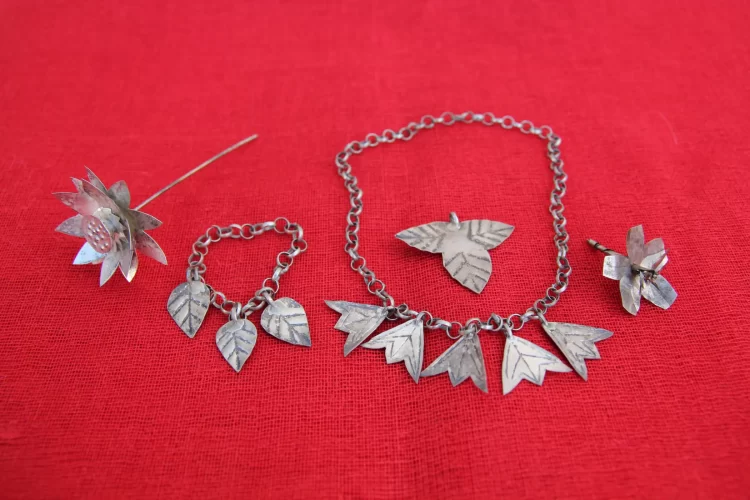
Photo Credit: Astrid Zotter
Caption: Miniature crafted flowers photographed at a metalsmith’s shop in the old Kathmandu palace square. These ornaments represent a centuries-old practice of offering crafted metal flowers to deities.
We experiment with digital tools to explore, preserve, and share knowledge, creating interactive archives, maps, and resources.
We study the tools, practices, and materials of work, offering insights into the ways in which people strove, pursued purpose, and made meaning across time.
Photo Credit: Eva Kafle
Contemporary hand made lokta paper with pressed bougainvillea petals and ferns. Today, such lokta paper is used to make notebooks, envelopes, and greeting cards. For at least a few centuries till the mid-20th century, handmade lokta was essentially the only kind of paper available for writing. Administrative documents, ritual and scholarly manuscripts, and artisanal manuals were all handwritten on lokta.