
Across the length and breadth of Nepal, there are places named khanigau, mining village. These enduring placenames are proof that mining was a widespread activity in the past. Many different materials – saltpeter, sulphur, copper, iron, graphite– were mined at different places across what is today Nepal. Materials were mined at notable scale through small mines reliant on human power. Efforts at increasing output through extension and intensification were ongoing. These mining pasts are part of a larger web of stories about systems of work, skill, labour, and technologies that thread together communities, knowledge cultures, markets and everyday life.
Yet mining and other productive activities have been all but written out of histories that portray Nepal as an almost entirely agrarian country. Conversations interrogates this narrative through oral history accounts, community-based reflections, archival research, spatial and landscape studies, and explorations in material culture. Conversations presents its counter-stories through a digital exhibition that includes a geolocated map of historical mining sites across the country and tells detailed stories of a dozen such sites through interviews with descendants of mining communities, videos and photos of mining tools and sites, and interactive multi-media tools that draw from historical sources.
Through the digital exhibition, Conversations aims to start generative discussions that take the legacies of historical mining as a starting point to reflect on future pathways of work. This is an urgent issue today as the lack of employment opportunities was a major factor sparking protests in Nepal and other places in the Global South in 2025. In this moment of intense debate about developmental pathways, Conversations thinks together with communities and asks questions about what it takes to make dignified livelihoods possible.
The KaMM Center serves as an institutional host for Conversations which is a collaborative project between four researchers from across different disciplines and with personal histories intertwined with the legacies of mining:
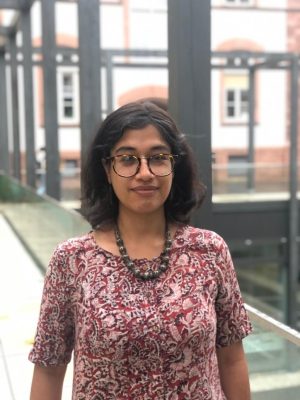
Surabhi Pudasaini is the research director of the KaMM Center. She brings her research on artisanal mining in Nepal and elsewhere as well as commitment to the public huma nities as a tool to challenge entrenched narratives and foster alternative thinking to the project.
Gobinda Chhantyal is an activist, researcher, and indigenous leader. He was Vice Chair and Foreign Affairs In-Charge of the Nepal Federation of Indigenous Nationalities (NEFIN), an umbrella organization representing 59 indigenous communities, from 2017 to 2022. He also served as a Governing Council member of the National Foundation for Development of Indigenous Nationalities (NFDIN), an autonomous body of the Nepal Government, from 2017 to 2021. At present, he is an advisor to the Nepal Chhantyal Association, and co-founder of Indigenous without Borders (IwB), a collective committed to social justice and indigenous knowledge.
He has conceptualized and edited six collected volumes on topics including the politics of resistance, indigenous rights, and the Chhantyal community. His latest publication is a profile of Lamlekhani, a historical mining settlement in Baglung district. Gobinda brings his deep knowledge of the research areas, social memories of mining, and working relationships with community associations and social justice movements across Nepal to the project.
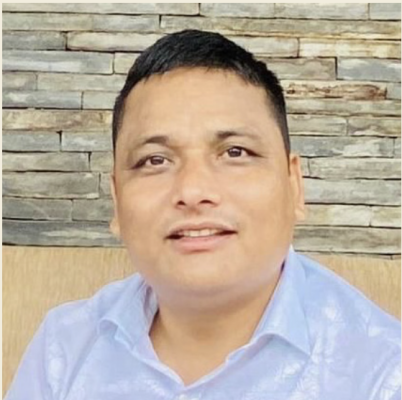
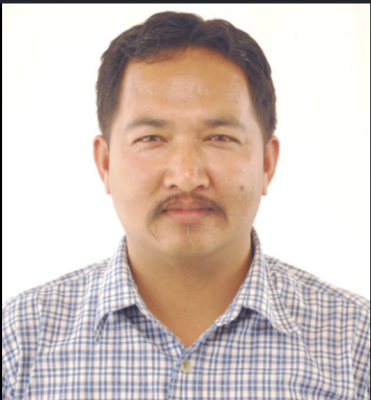
Khem Shreesh is a researcher and editor in Kathmandu. As a recipient of the Toni Hagen Fellowship in the Social Sciences and researcher and editor at Social Science Baha, Kathmandu, he has contributed to major editorial and conference publishing projects.
He is presently focused on the history of migration studies, with literature and folk arts as sites of expression and records. He is particularly interested in understanding how mobility (re)shapes identities of people and places, using oral and vernacular sources to trace such transformations. He has been contributing to efforts to document and publish the mining and military history of Bharse, his village, located in the northern reaches of the Gulmi District in West Central Nepal.

Jacob Rinck is an economic and political anthropologist broadly concerned with global inequality and specifically studying migration, agrarian change, and development institutions, with long-term research interests in Nepal, and more recently regional migration governance and climate politics.
Based on dissertation research funded by Wenner Gren (PhD Yale, 2020), he recently finished a book manuscript titled Empty Growth: Remittances and Economic Storytelling in Nepal. Currently at the NUS Asia Research Institute, he studies how private investors in forest carbon projects engage with ideas about risk. Jacob’s book manuscript and other publications build on extensive oral history interviews with former government officials, policymakers, agrarian elites, smallholders and agricultural laborers. He had an earlier career in development and conflict analysis, and continues to consult for the World Bank.
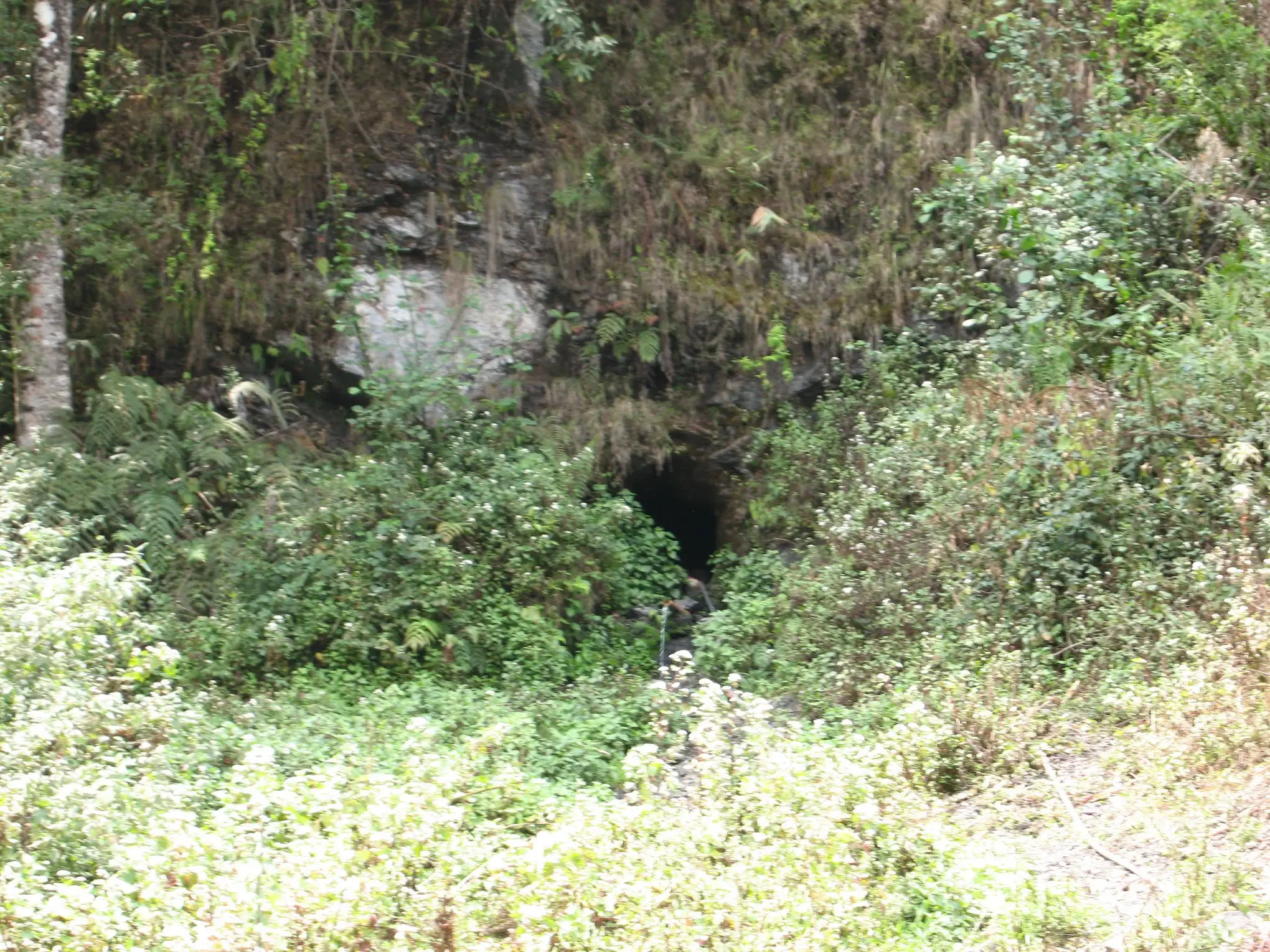
Photo Credit: Khem Shreesh
A long-defunct mining adit visible from the motorable road in Phoksing Village, Gulmi District in Nepal. The overgrown opening is a material reminder of the extensive mining that took place in Gulmi and other parts of West Central Nepal till the early 20th Century. The pipe with running water at the bottom of the tunnel suggests that the residents of Phoksing have repurposed the old mining infrastructure to serve their contemporary needs.
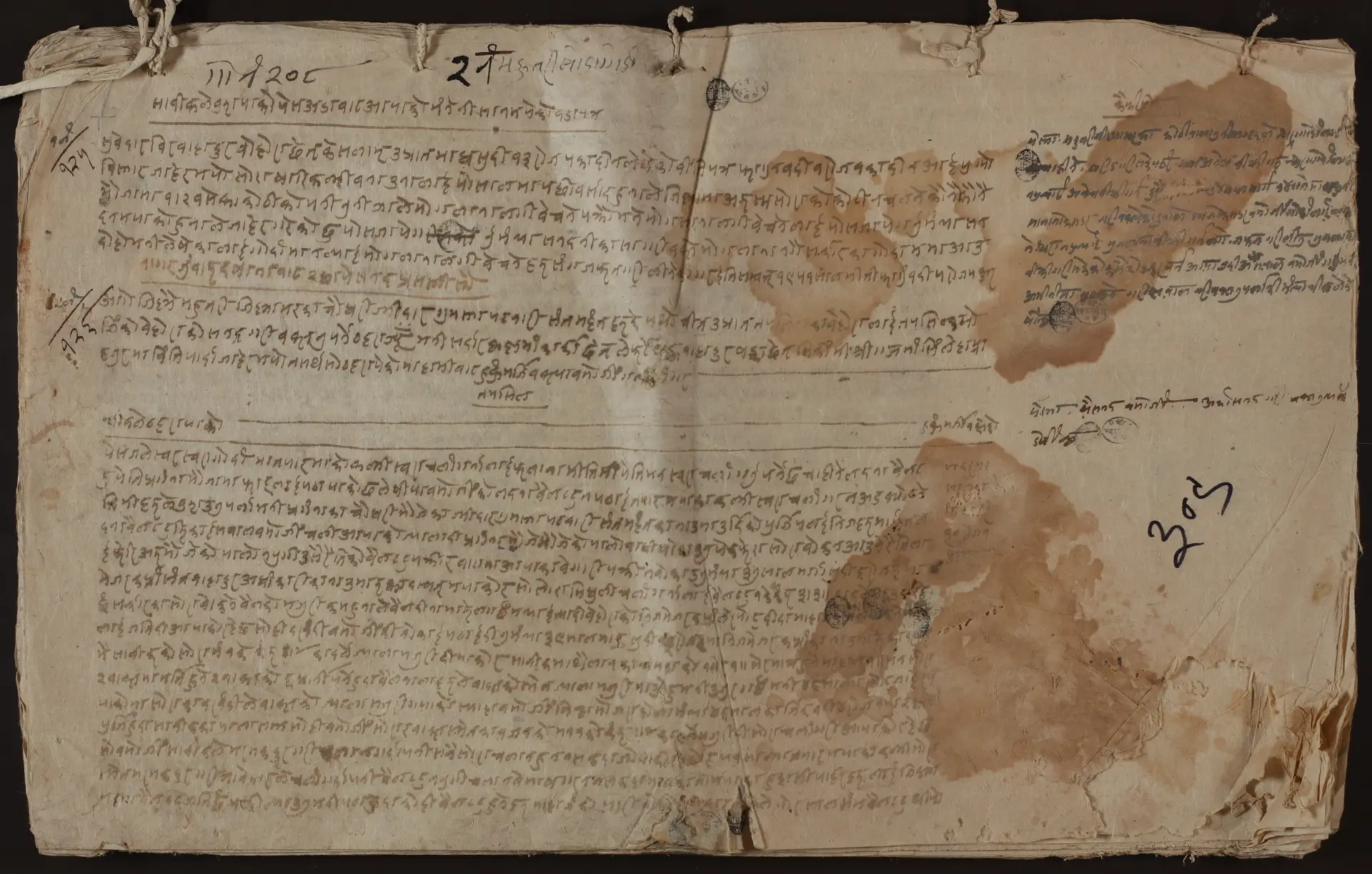
Photo Credit: National Archives of Nepal, Kathmandu
A multi-page, bound document compiling instructions from the second half of the 19th Century pertaining to the buying, refining, storing, and transportation of Saltpeter—a key ingredient in the production of gunpowder—by the Saltpeter Godown in the plains town of Jaleshwar in eastern Nepal.
Pursuing the KaMM Center’s commitment to public histories, Surabhi Pudasaini writes a weekly substack titled Back Up a Sec: Unwritten Histories from Nepal and Beyond. The newsletter brings resonant stories about relationships, places, and things from Nepal’s past to readers seeking to reflect on lives that were, imagine what could be, and shape what is to come.
At present, Back Up a Sec is narrating a serialized story about a complicated family dispute taking place in 1870s and 1880s Kathmandu, followed by a sequel and a prequel. At first glance, the story seems a straightfoward fight over property. Slowly, details emerge about the transgression of an incest taboo and the consequent loss of caste status of multiple family members.
This complicated case allows precious insights into the time and place in which these people lived. It gives us a peek into the household of one branch of a sprawling lineage that diligently traced its genealogy back centuries and prided itself on its service to kings and rulers. It lets us brush up against the people who served these elites and the things they surrounded themselves with. It allows us to partake of the stories they told of themselves. It lets us take stock of the lands they held, the valuable items they stored, and how they managed these assets. It lets us follow the twist and turns of a legal and political system adjudicating in real time. It calls on us to make sense of the strategies each of the three claimants used in light of their familial networks and the boundaries of the society they lived in.
In sum, it lets us understand how individuals and families could or were unable to manage the simmering tensions and rending crises that are common to families – particularly joint families that are deeply bound together in physical and financial proximity – everywhere.
The Back Up a Sec logo inspired by the elaborate and ornamented administrative seals and stamps of the 19th Century Gorkhali state.
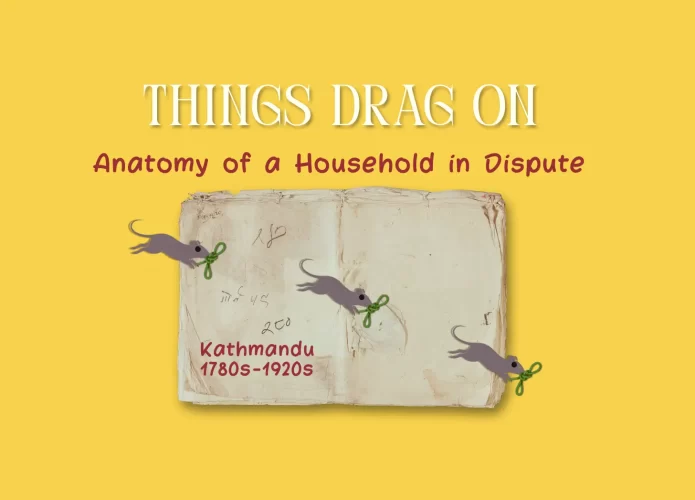
Cover image for a story exploring a dispute within an elite Kathmandu family that centers on questions of property, caste, and gender.
Photo Credit: Eva Kafle
Contemporary hand made lokta paper with pressed bougainvillea petals and ferns. Today, such lokta paper is used to make notebooks, envelopes, and greeting cards. For at least a few centuries till the mid-20th century, handmade lokta was essentially the only kind of paper available for writing. Administrative documents, ritual and scholarly manuscripts, and artisanal manuals were all handwritten on lokta.